Source Plastic Mud Guard for Cars, Trucks, and SUVs
Find 30 listings for plastic mud guard designed for front and rear fenders on cars. Buyers can compare models like 208010 and 61090, materials including PP and ABS, and specifications from Zhejiang and Tianjin suppliers.
Key considerations
Products List




Comprehensive Sourcing Guide
Strategic Sourcing Guide for Plastic Mud Guards
Understanding Technical Specifications and Material Composition
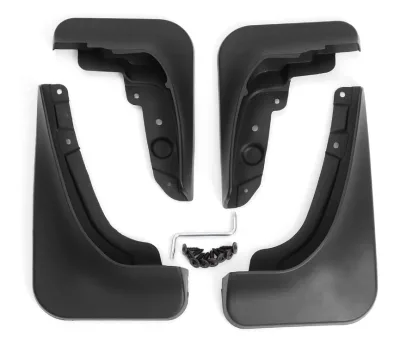
When sourcing plastic mud guards, also known as mud flaps or exterior protection parts, buyers must first establish a clear understanding of the technical specifications that define product viability. The core material composition is a primary determinant of performance, with the supply market heavily featuring Polypropylene (PP) and Acrylonitrile Butadiene Styrene (ABS). These materials are selected for their balance of flexibility, impact resistance, and weatherability. In the current market, specific product models such as 208010, 208013, and 208014 demonstrate the variance in physical dimensions that buyers must account for. For instance, the model 208010 is characterized by dimensions of 32022811MM, while model 208013 measures 4102553MM. Other variations include model 208014 at 4302353.5MM, model 208009 at 2852453MM, and model 208004 at 3202183MM.
The manufacturing process is equally critical to the final product's integrity. Most high-quality units are produced via injection molding, a process that ensures consistent wall thickness and structural strength. The product name often appears as "Mudguards Exterior Parts Protection," indicating their specific function in shielding the vehicle body from road debris. Buyers should verify the specific molding type, as "Injection" is the standard for durable automotive applications. Furthermore, the weight of the unit is a significant logistical factor; observed weights in the market range from 3.05kg to 3.45kg depending on the model and thickness. For example, specific listings indicate weights of 3.45kg, 3.15kg, and 3.05kg for different configurations. These variations directly influence shipping costs and the ease of installation on the vehicle.
Compliance, Certification, and Quality Standards
Navigating the compliance landscape for automotive exterior parts requires rigorous verification of certifications and standards. While general industry knowledge suggests ISO 9001 as a baseline for quality management, the specific data available highlights "ISO/TS" and "ISO" certifications as relevant markers for suppliers. Buyers must treat these certifications as observations of specific supplier capabilities rather than universal guarantees for every listed item. The presence of an ISO certification indicates that the manufacturer has established a documented quality management system, which is essential for maintaining consistency in mass production.
In addition to organizational certifications, buyers must scrutinize the product standards themselves. The supply data references specific dimensional standards, such as 32022811MM for model 208010, which serve as the technical baseline for fitment. It is imperative to verify that the supplier's production aligns with these precise measurements to ensure compatibility with the intended vehicle models. The "Fitting Position" is another critical compliance metric, with products explicitly designated for "Front Fender" and "Rear Fender" applications. Misalignment in these positions can lead to installation failures or aesthetic issues. Furthermore, the "OEM" (Original Equipment Manufacturer) status is listed as "Acceptable," suggesting that suppliers are capable of producing parts that meet or exceed original equipment specifications, though buyers must confirm the specific OEM standards required for their target market.
Cost Drivers and Pricing Dynamics
The pricing structure for plastic mud guards is influenced by a complex interplay of material costs, order volume, and logistical factors. The observed price range in the market spans from $0.05 to $20.00 USD, a wide variance that reflects differences in material grade, manufacturing complexity, and order quantity. The Minimum Order Quantity (MOQ) is a significant driver of unit cost, with observed ranges extending from 5 units up to 50,000 units. However, specific high-confidence data points to an MOQ of 500 sets for certain product lines, which serves as a baseline for competitive pricing. Buyers should anticipate that orders falling below this threshold may incur higher per-unit costs or require special negotiation.
Logistics also play a pivotal role in the total cost of ownership. The "Delivery Time" is cited as 25-30 days, with some specific listings noting a "D/T" of 30 days. This lead time must be factored into inventory planning and cash flow projections. Additionally, the origin of the products, primarily from "Zhejiang, China" and "Tianjin, China," impacts shipping expenses. The designated ports of "Shanghai or Ningbo" are standard for export from these regions, and buyers should calculate freight costs based on these departure points. Packaging is another cost variable; products are shipped in configurations such as "2PCS/OPP Bag + Color Card," "Box+Pallet," "Netural Box," or "Carton." The choice of packaging affects the density of the shipment and the protection level of the goods during transit, which can influence the final landed cost.
Typical Applications and Vehicle Compatibility
Plastic mud guards are designed for a broad spectrum of automotive applications, with the primary use case being "Car" and "Auto application." Their function is to protect the vehicle's bodywork, suspension components, and other critical parts from the spray of mud, water, and debris kicked up by the tires. The specific "Fitting Position" dictates the application; units are engineered for either the "Front Fender" or "Rear Fender," and sometimes both. This distinction is crucial for buyers sourcing parts for specific vehicle models, as the curvature and mounting points differ significantly between front and rear positions.
The versatility of these parts extends to various vehicle types, though the data specifically highlights "Car" as the primary application. The availability of customization options allows manufacturers to tailor the product to specific vehicle brands and models. The "OEM: Acceptable" attribute suggests that these parts are suitable for replacement markets where original equipment specifications are required. Buyers should verify the compatibility of specific model numbers, such as 61090, 61010/61020, 61030/61040/61050, and 1060, with their target vehicle inventory. The "Brand Name" DQ is noted in the supply data, indicating that some products are branded, while others may be generic or "Netural Box" packaged for private labeling. Understanding the specific application context helps in selecting the correct material thickness and mounting hardware to ensure optimal performance.
Supplier Evaluation and Operational Capabilities
Evaluating a supplier for plastic mud guards requires a multi-faceted approach that goes beyond price comparison. The "Processing Service" is identified as "Moulding," specifically "Injection" molding, which is the industry standard for producing high-volume, consistent plastic parts. Buyers should verify the supplier's capacity to handle injection molding, as this process ensures the structural integrity required for automotive applications. The "Condition" of the products is consistently listed as "New," which is a baseline expectation but should be confirmed during the inspection phase.
Geographic location is a key factor in supplier evaluation. The primary production hubs identified are "Zhejiang, China" and "Tianjin, China." These regions are known for their robust manufacturing ecosystems, but buyers should assess the specific logistics capabilities of the supplier within these locations. The "Port" of shipment is typically "Shanghai or Ningbo," which are major international gateways. Buyers should confirm the supplier's experience with export procedures and their ability to manage documentation for these specific ports. Additionally, the "Product Name" and "Model Number" consistency should be verified to ensure that the supplier can reliably produce the exact specifications required. The availability of "Customization" is a significant advantage, allowing buyers to request specific colors, such as "Black," or tailored dimensions to meet unique market demands.
Quality Control and Long-Term Procurement Strategy
Implementing a robust quality control (QC) strategy is essential for mitigating risks in the procurement of plastic mud guards. Given the wide range of observed weights and dimensions, buyers must establish clear acceptance criteria based on the specific model standards. For example, verifying that a unit matches the 32022811MM standard for model 208010 is a critical QC step. The "Certification" status, such as ISO or ISO/TS, should be validated through third-party audits or recent documentation to ensure the supplier maintains their quality management systems.
Long-term procurement considerations involve building a relationship with suppliers who can offer consistent quality and reliable lead times. The "Delivery Time" of 25-30 days is a standard benchmark, but buyers should negotiate terms that account for potential delays. The "Packing" method, whether "OPP Bag + Color Card," "Box+Pallet," or "Carton," must be agreed upon to prevent damage during transit. Furthermore, the "Weight" of the product, ranging from 3.05kg to 3.45kg, affects storage and handling requirements, which should be factored into the warehouse management plan. By focusing on these operational details and maintaining a clear understanding of the technical specifications, buyers can secure a steady supply of high-quality plastic mud guards that meet their market demands.
Final Sourcing Considerations and Verification Checklist
To conclude the sourcing process, buyers should utilize a verification checklist to ensure all critical parameters are met before finalizing an order. This checklist should include confirmation of the material type (PP or ABS), the specific model number (e.g., 208010, 61090), and the dimensional standards. It is also vital to verify the "Fitting Position" and ensure the product is suitable for the intended "Car" application. The "OEM" acceptability and "Customization" options should be explicitly discussed to align with brand requirements. Finally, buyers must confirm the "MOQ" of 500 sets or negotiate a lower threshold if possible, and ensure the "Delivery Time" of 25-30 days fits within their supply chain timeline. By adhering to these guidelines and relying on the provided facts, buyers can navigate the plastic mud guard market with confidence and efficiency.
FAQs
What materials are used for plastic mud guards?
Plastic mud guards are primarily manufactured using Polypropylene (PP) and Acrylonitrile Butadiene Styrene (ABS). These materials are selected for their balance of flexibility, impact resistance, and weatherability to ensure durability in automotive applications.
Which models have specific dimensional standards?
Several models have defined dimensional standards, such as 208010 measuring 320*228*11MM and 208013 measuring 410*255*3MM. Buyers must verify these specific measurements to ensure compatibility with their intended vehicle models and fitting positions.
Can suppliers offer customization for these parts?
Yes, customization is available for plastic mud guards to meet specific buyer requirements. This allows manufacturers to tailor the product to specific vehicle brands, including options for colors like black or tailored dimensions.
What is the typical delivery time for orders?
The standard delivery time for these products ranges from 25 to 30 days. Some specific listings note a delivery time of 30 days, which buyers should factor into their inventory planning and cash flow projections.
Which certifications do the suppliers hold?
Suppliers often hold ISO and ISO/TS certifications to demonstrate quality management systems. These certifications indicate that the manufacturer has established documented processes to maintain consistency in mass production of automotive exterior parts.
What is the minimum order quantity for these items?
The minimum order quantity is typically 500 sets for certain product lines. While observed ranges extend from 5 to 50,000 units, orders below the 500-set threshold may incur higher per-unit costs or require special negotiation.
Where are these products manufactured and shipped from?
Products originate from manufacturing hubs in Zhejiang and Tianjin, China. They are typically shipped from major ports such as Shanghai or Ningbo, which impacts logistics costs and export procedures for international buyers.